
From 2007 garage to global company: the Build a Phone Empire loop of design, pricing, hiring, research and launch explained.
Build a Phone Empire Beginner Guide (2026)
Build a Phone Empire drops you into a garage in 2007 and asks you to build the biggest phone company in the world. The loop is five verbs the developer lists on the tin — design every device, build your office, hire a team, research new tech, launch with marketing — and this guide walks each one in the order a new company actually meets them.
The game comes from DEVTEC STUDIOS and has climbed fast: about 2.2 million visits and an eleven-thousand-plus concurrent player count in its first three weeks, with a roughly 84 percent positive rating. Servers hold up to 8 players, progression auto-saves to your Roblox account, and the developer ships updates every three to four days.
Minute One: The Garage
Every company starts the same way, which makes the opening steps easy to memorize:
- Claim the codes first. The active codes —
LAPTOPS,WELCOME,CEO— grant Cash and RP through the Store menu's Codes tab. Banking them before your first design session means better parts on phone one. - Walk the tutorial. The game walks you through the design screen, the price setting and your first launch; the flow you learn here is the same one you will repeat every in-game year.
- Ship your first phone. It will be bad by late-game standards and fine by 2007 standards. The point is the loop, not the device.
Official source: Build a Phone Empire on Roblox — the developer's description is the game's own tutorial-in-text: design "screen size, cameras, corners, buttons, colour, finish and logo," then "pick the parts, set the price and hand it to your team."
The Design Screen: Your First Real Decision
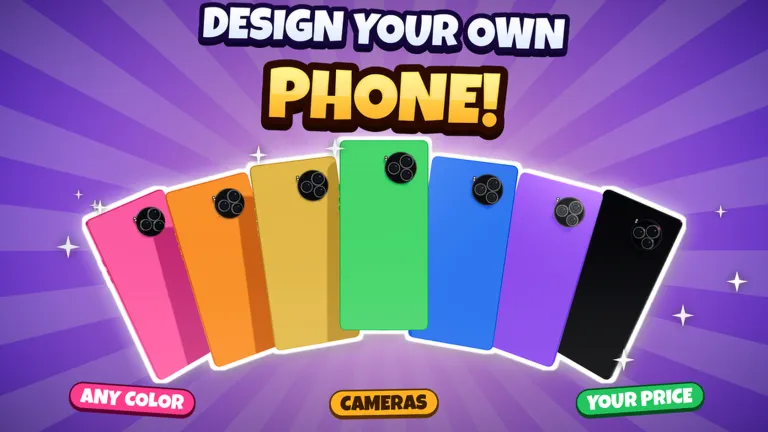
Phone design is the game's signature system, and the official description names every axis: screen size, cameras, corners, buttons, colour, finish and logo. Each choice pulls from a parts catalog with costs attached, and the sum of your choices sets both the production cost and the review score the market will give your device.
Beginner guidance that holds up:
- Match parts to your target price, not to your taste. A flagship screen on a budget phone is margin death; the design guide covers the trade-offs per component.
- Ship something every year. The research tree rewards cadence — income from each launch funds the next design, and idle years fund nothing.
- Iterate, don't perfect. Your third phone teaches more than your first perfect one, because pricing feedback is where the real game lives.
The loop structure here follows the game as covered by Pro Game Guides and Destructoid, whose guides describe the same five-verb flow.
Pricing: Where Games Are Won
The official description gives you three words — "set the price" — and the whole economy hides in them. Price against production cost determines margin; price against market expectations determines review scores and demand. A phone priced above its parts' reputation sells slowly and reviews poorly; a phone priced too low moves units and starves your research fund.
The practical opening heuristic: price your first phones just above parts cost to build a customer base, then let the pricing guide's margin logic take over as your brand grows. Reviews compound — a company known for fair pricing sells its risky flagship designs that a no-name startup could not.
Cash buys parts, but review scores buy demand. Every design decision that protects your rating — honest pricing, coherent parts — pays out across every future launch, which is why the pricing screen deserves more attention than the design screen once your first three phones ship.
Hiring and the Office
Two systems grow your company's throughput. Hiring puts a team in your office — and the game's signature twist is that your Roblox friends appear as candidates, working in your office as their real avatars. More staff means more design and production throughput per year.
The office itself is buildable: walls, doors, floors, paint, desks and decorations, expanding from a garage to a headquarters. Office building is partly throughput (more desks, more staff capacity) and partly the tycoon pleasure it is in every game of this genre. The employees and office guide covers the build order.
Research: The Long Game
RP — Research Points — unlocks the tech tree year by year: tablets, smartwatches, earbuds, foldables and eventually laptops, per the official description. Each unlock widens what you can design and sells, which is why research pace roughly equals company growth pace.
The research guide covers priority, but the beginner version is short: unlock the device categories that match what you can afford to design, not the flashiest badge on the tree. A foldables unlock you cannot fund is a shelf trophy.
Launch and Marketing
Designing a phone and selling it are different skills, and the launch step — "LAUNCH with a marketing campaign," per the official description — is where demand gets manufactured. Marketing spend pushes reach; the timing and tier choices around it are where margin gets won or burned. The marketing guide treats this in full.
Your First Session, Condensed
- Redeem codes, walk the tutorial, ship phone one.
- Price it honestly and note the review score.
- Ship a second phone fixing whatever the first got wrong.
- Hire your first team members when Cash allows.
- Put every spare unit of RP into one research branch.
- Reinvest launch income into a bigger office before your fourth phone.
Six steps, one session, and you have touched every system the endgame uses. Everything after that is scale.
Three Beginner Mistakes That Compound
- Designing your dream phone in year one. Parts cost money before revenue exists, and a flagship build in a garage economy bankrupts faster than it ships. Match the design to the decade's market, not to the endgame catalog.
- Skipping marketing on early launches. A good phone with no campaign sells to nobody — reach is manufactured, and the launch step is where early companies stall. Even the cheapest campaign beats silence.
- Researching everywhere at once. RP is scarce early, and a tree touched in five places unlocks nothing anywhere. One branch at a time until income supports two.
Each mistake is survivable — auto-save means no permadeath — but all three compound: a bad design sells poorly, a stalled launch earns nothing, and scattered research slows the recovery. The fixes cost nothing and take one session to adopt.
FAQ
Is Build a Phone Empire free to play?
Yes, with the standard Roblox model: the game is free, and a handful of gamepasses sell convenience perks — the gamepass guide lists them with prices. Codes grant the same currencies the passes accelerate.
How long is a full game of Build a Phone Empire?
Sessions are as long as you want — the company auto-saves to your Roblox account, and the year-by-year structure means a satisfying arc fits in a sitting while long-term goals (full tech tree, headquarters office) span multiple sessions.
What do my friends do in Build a Phone Empire?
They show up as job candidates. Hired friends work in your office as their real Roblox avatars, which is the game's signature social twist on the tycoon hiring screen.
How do I get more Cash in Build a Phone Empire?
Ship phones at honest prices (reviews drive demand), complete goals for milestone rewards, redeem codes for lump sums, and consider a Legacy reset once your company is mature — the rebirth grants permanent bonuses.
Is Build a Phone Empire multiplayer?
Servers hold up to 8 players, so you share the space with others, but companies are individual — your friends participate as hired staff avatars rather than co-owners.
Related Guides
- Codes (October 2026) — the free Cash and RP this guide assumes you claimed.
- Phone design guide — every design axis in detail.
- Research and tech tree — the long-game unlock order.
- Pricing and sales — the margin logic behind "set the price."
More Build a Phone Empire Guides
How phone design works in Build a Phone Empire: screens, cameras, corners, buttons, colours, finish and logo choices that sell.
Set phone prices in Build a Phone Empire without killing demand: parts cost, review ratings and profit margins explained.
Research in Build a Phone Empire: how RP flows, what each year unlocks from tablets to foldables and which tech to buy first.