
How phone design works in Build a Phone Empire: screens, cameras, corners, buttons, colours, finish and logo choices that sell.
Build a Phone Empire Phone Design Guide
Phone design is the signature system in Build a Phone Empire: every device you ship is assembled from parts you choose across seven axes the developer lists outright — screen size, cameras, corners, buttons, colour, finish and logo. Pick the parts, set the price, and hand the result to your team. This page walks each axis and the design logic that turns parts into review scores.
The official description is the authoritative word on what the system covers: "DESIGN every device yourself: screen size, cameras, corners, buttons, colour, finish and logo. Pick the parts, set the price and hand it to your team." What it does not publish is the stat math behind each part — community wikis attempt it, and this page keeps those claims clearly labeled.
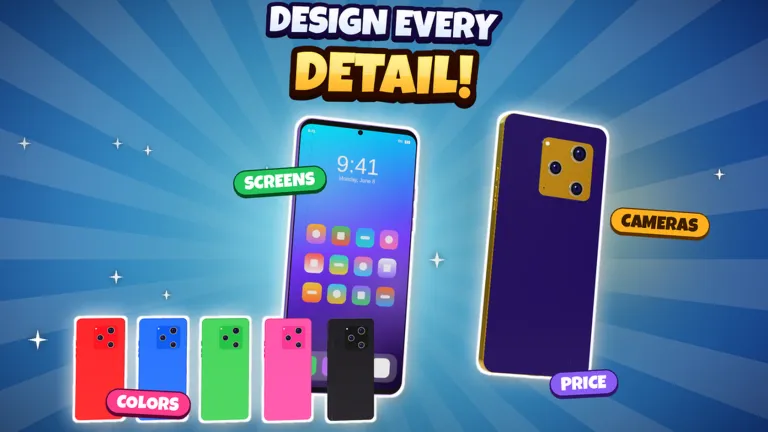
The Seven Design Axes
Each axis is a decision with a cost and a consequence:
- Screen size — the most visible spec on the box. Bigger screens read as premium but raise parts cost; the market segment you target should set this before anything else.
- Cameras — the spec players historically overpay for. More and better cameras raise cost steeply, and mid-tier devices rarely earn the spend back.
- Corners — a silhouette choice as much as a spec. Rounded versus squared changes how the device reads next to the previous year's model.
- Buttons — a small cost line with a usability read; the game treats it as part of the device's coherence rather than a headline spec.
- Colour — pure presentation, no performance implication. The fan wikis document default palettes and premium finish shades; the design screen shows your options directly.
- Finish — the material story of the device, from plastic to premium builds. Finishes push cost and perceived quality together.
- Logo — your brand on the device. Cosmetically free, strategically central: the logo is what repeat buyers recognize across generations.
Official source: Build a Phone Empire on Roblox — the developer's description is the definitive list of design axes, quoted above; the design screen implements each one directly.
The design-then-price sequence tracks Pro Game Guides' coverage of the game's loop, and Destructoid's guide documents the same design-forward structure from the codes angle.
Parts, Cost and the Review Loop
Every part pick carries a cost, and the sum sets your production floor. The pricing decision then happens against that floor — but the review score is where design quality actually bites. Review ratings drive demand, and demand is what turns a shipped phone into a company.
The loop, in practice:
- Design to a target segment. Decide who the phone is for before opening the parts catalog; a budget device with one premium part is worse at both price points.
- Keep the parts coherent. A flagship screen beside a budget camera reads as a bad value at any price. Reviews punish incoherence harder than they punish modesty.
- Ship, read the reviews, adjust. Each launch teaches you what the current market rewards; the design screen lets you iterate the same chassis year over year as parts improve.
The most common design failure in tycoons like this is the flagship-screen-budget-phone hybrid: expensive where it shows, cheap where it counts. Reviews read the whole device, and a coherent mid-tier phone outsells an incoherent flagship at the same price.
What the Community Data Says (And What It Can't)
The fan-maintained wikis for this game attempt part-by-part stat tables and "best phone" builds, and they are useful as starting points — but none of those numbers are officially documented, the game updates every three to four days, and two competing fan wikis do not always agree with each other. Treat any specific part-value claim as community-reported and verify against your own review scores.
What is safe to build on: the axis list itself (official), the cost-then-price sequence (official), and the general tycoon logic that reviews compound. Everything past that is your own lab work, and honestly, that is the fun part of the genre.
Designing Across Device Categories
Research unlocks new product families over time — the official list runs tablets, smartwatches, earbuds, foldables and laptops — and each family inherits the same design logic with different part pools. The first device in a new category is always your worst margins: you are designing against an unknown review curve with parts you have never priced.
Two habits smooth the transition: ship a conservative first model in any new category (coherent, mid-tier, honestly priced), and let the category's second generation carry the ambition. By then your reviews from generation one tell you what the market for that form factor actually rewards.
The Logo Question
It is worth stating plainly because players underrate it: the logo is the only design axis that persists across every device you ever ship. Screens improve, cameras change, finishes rotate — the brand mark is the one thing your review history attaches to. A recognizable logo on coherent devices builds the kind of demand that makes flagship launches self-selling, which is the entire endgame of the design system.
Reading the Design Screen Like a Product Manager
The seven axes feel like a character creator, but the successful mental model is a product brief: who is this for, what does it promise, and does every part keep that promise? Players who treat the screen as a spec-maxing game produce expensive incoherence; players who write a one-line brief before touching parts — "a reliable 2009 mid-range phone under a fair price" — ship coherent devices without touching a wiki.
The brief also disciplines upgrades across generations. When research adds a better screen tier, the brief decides whether it belongs in next year's model or whether this year's line stays put while the savings fund a camera bump. Devices that chase every new part read as oscillating; devices that serve a brief read as a brand, and reviews reward brands.
Design Briefs Across a Company's Life
The one-line brief changes as the company grows, and knowing its shape per era keeps designs coherent: the garage era's brief is affordability ("a working phone cheaper than the repair"), the growth era's brief is reliability ("the phone that reviews honestly"), and the headquarters era's brief is ambition ("the flagship the brand earned"). Designers who keep the same brief from 2007 to the foldable years produce devices that fight their own market; designers who re-brief per era produce a catalog that reads like one company's history.
The logo ties those eras together on every device box — which is the quiet argument for treating it as a design axis rather than a decoration. The brand mark is the only element that appears in every era's brief, and the consistency it provides is what makes each re-brief read as evolution instead of reinvention.
FAQ
What design choices matter most in Build a Phone Empire?
The ones that keep the device coherent: screen, cameras and finish pulling in the same market direction. Review scores reward a device whose parts tell one story, and they punish flagship-midrange hybrids regardless of price.
Does colour affect sales in Build a Phone Empire?
Colour is presentation, not performance — the official design axes list it as a choice, not a stat. It personalizes the device and pairs with your logo; the fan wikis document palette options including premium finishes.
How do I design a phone that gets good reviews?
Match parts to a target segment, price honestly against the parts cost, and iterate on the review feedback each launch gives you. There is no published review formula — the loop of ship, read, adjust is the reliable path.
Can I redesign an existing phone?
No — each launch is a new design decision. The game's year-by-year structure is built around shipping the next device with the lessons of the last one, not editing history.
What is the best first phone to design?
A coherent mid-tier device priced just above parts cost. It reviews fairly, sells steadily, and the feedback teaches you the market — the flashy flagship is a year-two project once reviews and Cash support it.
Do unlocked device categories change the design system?
They widen the parts pool, not the rules. Tablets, smartwatches, earbuds, foldables and laptops follow the same seven-axis logic with their own parts, so the design instincts you build on phones transfer directly.
Related Guides
- Pricing and sales — the decision that turns this page's parts into margin.
- Research and tech tree — where new categories and parts come from.
- Marketing guide — how launches get the audience your design deserves.
- Beginner guide — the full loop this system sits inside.
More Build a Phone Empire Guides
How marketing works in Build a Phone Empire: campaign types, launch timing and when an ad push actually pays for itself.
Set phone prices in Build a Phone Empire without killing demand: parts cost, review ratings and profit margins explained.
Research in Build a Phone Empire: how RP flows, what each year unlocks from tablets to foldables and which tech to buy first.