
All six Pixel Lineage classes, Super branches, and the best picks for new players in this roguelike RPG.
Pixel Lineage Classes: List and Best Picks
Pixel Lineage offers six starting classes — Warrior, Thief, Mage, Fist, Bard and Archer — shown as portraits on the class select screen. Your pick sets your weapon, skills and playstyle, and each class later branches into three Super paths. New players should start with Warrior or Mage for the simplest learning curve.
- Six starting classes, picked by you at character creation (unlike races, which come from a roll)
- Each class splits into three Super branches as you progress
- Warrior and Mage are the easiest to learn; Thief and Fist punish mistakes harder
- Pair your class with a sturdy race and talent from the race and trait combo guide
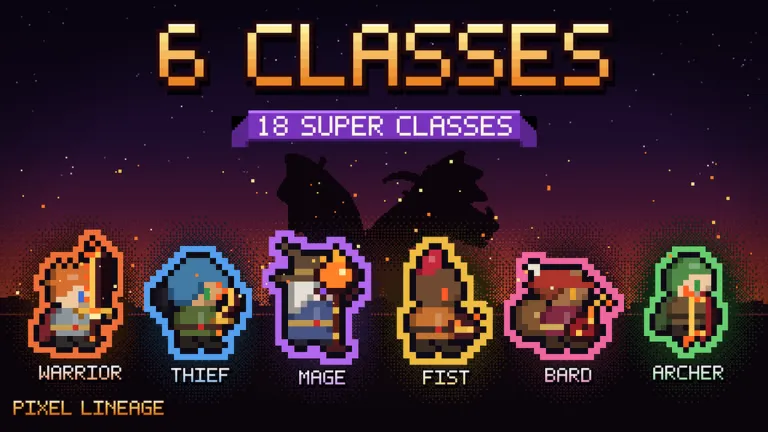
The Six Starting Classes
Classes work differently from races in one important way: you choose. When you create a hero, the race comes from a spin, but the class screen lets you pick freely among six portraits. That choice locks in your weapon type, your skill kit and the general rhythm of your runs, so it pays to understand all six before committing. The table below summarizes each class as presented on the selection screen.
| Class | Fighting Style | Learning Curve | Suits |
|---|---|---|---|
| Warrior | Close-range melee, steady damage | Easy | First runs, learning boss patterns |
| Thief | Fast strikes, hit-and-run | Medium | Players who like speed over bulk |
| Mage | Ranged casting, burst damage | Easy | Safe damage from a distance |
| Fist | Close-range brawling, aggressive | Medium-Hard | Confident dodgers, high-risk runs |
| Bard | Support-style skills, tricky timing | Medium | Team-minded players, patient learners |
| Archer | Ranged attacks, positioning game | Medium | Players who read enemy movement well |
Warrior is the default recommendation for a reason. Melee range keeps your decision-making simple — walk up, trade hits, learn when to back off — and mistakes cost less when your kit is straightforward. Mage earns its beginner spot differently: range lets you deal damage while staying out of the danger zone, which matters in a game that openly warns it is not meant to be easy.
Thief and Archer reward players who already read enemy movement. Both deal their damage by controlling distance, and both fall apart when you misjudge a boss pattern. Fist is the most punishing starter because it demands both aggression and precision at close range. Bard sits apart from the rest with a support-flavored kit that shines once you understand what your team or your build actually needs.
Official source: Pixel Lineage on Roblox — the official page describes a fast turn-based roguelike RPG with weekly updates, and the class select screen inside the game shows all six portraits.
One honest caveat: exact skill numbers and cooldown text live in the game client, not on any public tracker. The class overviews on the Classes wiki page confirm the structure, but always trust the in-game descriptions over any guide when numbers differ after a patch.
Super Branches: What Three Paths Mean
Every class eventually splits into three Super branches. The wiki's Classes page confirms the three-branch structure, though full branch names and details are best read in-game since early documentation is still catching up with the weekly update pace.
Think of the base class as your foundation and the Super branch as your specialization. A Warrior who picks a defensive Super plays nothing like one who picks an aggressive Super, even though both started from the same portrait. This is why the starting pick matters less than new players fear: two players with the same class can diverge sharply by mid-game.
Super branch guides go stale fast in a game updated weekly. Choose the base class whose moment-to-moment play feels good, then read each Super description in-game before committing — the three options are shown before you lock in.
The practical rule is simple. Do not reroll a hero just because someone called your Super branch weak. Branch balance shifts with patches, and a class you play well beats a supposedly stronger class you fumble. Save your spins for races and talents, where randomness actually gates your options.
Best Class for New Players
If this is your first hero, the choice narrows to two. Warrior teaches you the game's spacing and turn rhythm with the most forgiving kit. Mage teaches you positioning and target priority while keeping enemies at arm's length. Both clear early content comfortably and both stay relevant into boss runs.
| Priority | Pick | Why |
|---|---|---|
| Safest first run | Warrior | Simple melee loop, easy to learn turn timing |
| Safest ranged run | Mage | Damage from distance, fewer panic moments |
| Second hero experiment | Archer | Tests positioning skill once basics click |
| Skip until confident | Fist | Demands close-range precision from run one |
Avoid starting with Fist or Thief if you are still learning how turns resolve. Fast classes feel great when they work, but they convert small mistakes into lost lives, and lives are the one resource you cannot farm back mid-run. The beginner guide walks through the full opening sequence if you want the complete first-hour plan.
New players also underestimate Bard. It is not weak, but its value depends on understanding fights first. A support-flavored kit in the hands of someone who cannot yet read boss patterns contributes less than a straightforward damage kit. Come back to Bard on your third or fourth hero.
Classes in Boss and Dungeon Runs
Early rooms forgive almost anything, but bosses and dungeons punish one-dimensional picks. Ranged classes like Mage and Archer control boss fights by attacking from tiles where many boss patterns cannot reach. Melee classes like Warrior and Fist must learn each pattern's safe windows, which takes longer but pays off with steadier damage once mastered.
Dungeon depth changes the math again. Longer runs reward sustain and consistency over burst, so classes with dependable output pull ahead of glass-cannon styles that spike early and fade. None of this means any class cannot clear — the roguelike structure means every class has winning runs — but your room for error varies a lot.
Check the tier list for the current community read on class strength across early, boss and dungeon content. Rankings there are dated per patch, which matters more than the order itself in a game this young.
How Class Fits Race and Talent
Class is only one third of a hero. Your race supplies passive bonuses and your talent adds a second layer, and the three multiply each other. A fragile class paired with a defensive race plays like a different character than the same class on an aggressive race. Full pairing logic lives in the best build guide, but the short version holds for every class:
- Fragile damage classes (Thief, Archer, Fist) want defensive or sustain passives from race and talent
- Sturdy classes (Warrior) can afford aggressive, damage-scaling passives
- Mage flexes either way, which is part of why it suits beginners
Because races come from spins and classes are free picks, most players build around whatever race they rolled. Rolled something tanky? Take Fist or Thief and cash in. Rolled something fragile? Warrior or Mage covers the weakness. The races guide explains the roll system and the traits guide covers the second wheel.
Skill values, branch tuning and spin costs shift with the weekly update rhythm. The six classes and the three-Super structure are stable facts; any specific damage number in any guide is a snapshot. When in doubt, the in-game text wins.
FAQ
What is the best class in Pixel Lineage for beginners?
Warrior for melee or Mage for ranged. Both have simple game plans that survive mistakes, and both stay useful into bosses and dungeons. The other four classes are viable but demand better positioning or timing from the start.
How many classes are there in Pixel Lineage?
Six starting classes: Warrior, Thief, Mage, Fist, Bard and Archer, all visible as portraits on the class select screen. Each one later branches into three Super paths, so the total number of distinct end states is much larger than six.
What are Super branches in Pixel Lineage?
Super branches are specializations each class unlocks as you progress — three per class. Your base class sets weapon and playstyle; the Super branch sharpens it toward a specific role. Read all three descriptions in-game before locking one in, since tuning changes with patches.
Can I change my class after picking it?
Your class is locked to the hero you created it on. If you want a different class, that means a new hero, which also means a new race roll. Spins from codes soften the cost, so redeem active codes before starting over — the codes page lists what is live now, and PCGamesN's codes tracker confirms the spin bundles each code grants.
Does class matter more than race?
Neither dominates on its own. Class sets your actions, race sets your passive bonuses, and talent adds a second modifier. A good hero needs all three pulling in the same direction, which is exactly what the best build guide assembles.
Related Guides
- Pixel Lineage races guide — how the race roll works and what passives to hope for alongside your class.
- Pixel Lineage traits guide — the talent wheel explained, so your second roll supports your class pick.
- Best race and trait combos — ready-made pairings for survival and boss runs.
- Best builds: full three-piece setups — class plus race plus talent templates for early and boss content.
More Pixel Lineage Guides
Pixel Lineage Roblox beginner guide: races, classes, spin rerolls, lives, first codes and early progression for new players.
Pixel Lineage traits guide: talent wheel mechanics, talent spin income, effect roles, race synergy and reroll priority.
Pixel Lineage Trello roadmap status, Discord and group links, update rhythm and where new codes land.