
Ride a Dino dinosaurs explained: more than 50 species from Common to Divine, the rarity bands, the dinosaurs you can actually name, and what each find earns.
Ride a Dino Dinosaurs and Rarity
Ride a Dino has more than fifty collectible dinosaur species, and the developer's store description puts the range plainly: "Tame and collect 50+ species, from Common all the way up to Divine", plus "Secret Dinos that only show up once in a while". That is the whole public roster information the game gives you, so this guide separates what is officially confirmed from what is community chatter, and then gets practical about the value of a tame.
The Rarity Bands
The game's own text establishes the ladder: Common at the bottom, Divine at the top, and Secret as a special category that sits outside the normal grind because those dinosaurs "only show up once in a while".
You can see the same ladder in the game's own panels. The Dino Machines list in the official preview video tags its entries with names that read as rarity and appearance tiers, including Mythic, Secret and Eternal on the strongest entries, alongside a colourful tag like Cosmo on a mid-tier dinosaur. The Auras panel adds another layer on top of the same idea, with aura rarities running Common, Uncommon, Rare, Epic, Legendary and Mythic.
So there are two related systems that both use rarity language:
- Species rarity, which decides how rarely a dinosaur shows up and how fast a tame of that species earns.
- Aura rarity, which decides how much stamina multiplier an aura gives you. Aura rarities run from Common through Mythic, and the top aura, Divine, is a Mythic-tier aura at level 11.
These get confused constantly. A Divine aura is not a Divine dinosaur. The auras guide covers the aura side, and this page covers the animals.
Dinosaurs You Can Actually Name
No first-party source publishes a full species list with stats, so any page claiming a fifty-row table of exact values is making it up. The names that can be confirmed come from the official preview video and the official screenshots.
Named in the official GamePreviewVideo: Pteranodon (the airline passes are Pteranodon skins), Sabertooth, Carnotaurus, Allosaurus, T-Rex, Compy, Parasaurolophus, Raptor, Ostrich, Giant and Serpent.
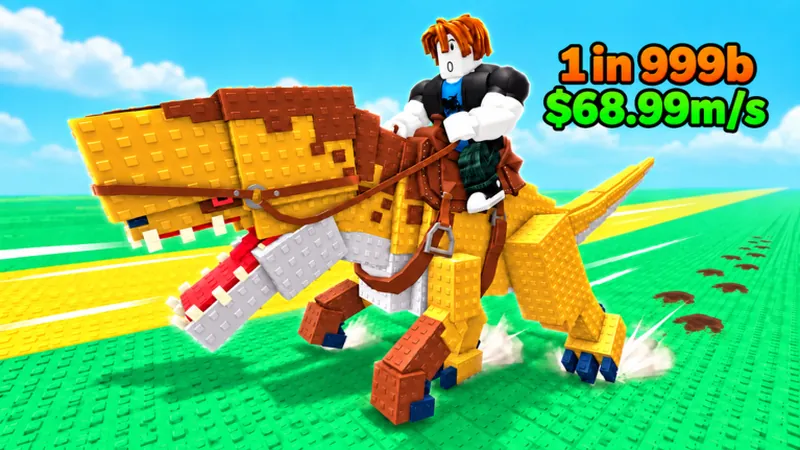
Named in the official screenshots: a golden dinosaur advertised at "1 in 999b" earning "$68.99m/s", the Magma T-Rex advertised at "1 in 900Qa" earning "$12.7B/s", a white dinosaur, and a pair of large brown theropods.
Named in community coverage: Pachycephalosaurus, Ankylosaurus and Triceratops show up in third-party Ride a Dino guides. Treat those as names worth recognising in game, not as an official roster. A guide that hands you a complete index with per-species speed values is not reading it from the game.
Ride a Dino has no published species database, no per-dinosaur stat sheet and no egg locations, because the game has no egg system. Any third-party table claiming a full fifty-species list with exact values is either reading from a different game or generating plausible filler. Use the in-game Index and the on-screen labels instead.
What a Tame Is Actually Worth
The official advertising gives you two hard numbers, and they show how steep the value curve is:
| Find | Advertised spawn rate | Advertised income |
|---|---|---|
| Golden dinosaur | 1 in 999b | $68.99m/s |
| Magma T-Rex | 1 in 900Qa | $12.7B/s |
One in 900Qa means one in nine hundred quadrillion, which is a deliberately impossible target for normal play. That number is marketing, and it tells you the top of the roster is not where a normal account earns its money.
Normal income comes from ordinary tames. The ranch HUD in the official video shows a tamed Ostrich earning $8/s, and the total ranch income sitting at $53/s. Those are the numbers that pay for machines, auras and airline passes, and they are worth far more to a new account than a rare find you will never land.
The third-party Magma Colossal T-Rex gamepass, which the developer has since delisted, advertised $560K/s in a pen. That is the clearest published example of how the income curve works between a common tame and a premium one, and it is why the ranch guide focuses on pen upgrades rather than on waiting for a jackpot.
How to Judge the Find in Front of You
Since the game does not publish a full stat table, use the labels it does show. When you land a tame, look at:
- The rarity tag on the creature, which uses the same bands as the rest of the game.
- The per-second income shown for it, next to the dollar sign, the same readout used for the Ostrich.
- The era you found it in, because the same species can appear in more than one zone.
- Your remaining stamina, because a Common find costs you a ride and a Common find in a late zone may cost more.
That four-part read tells you whether to keep, sell or replace a tame better than any copied table would.
Frequently Asked Questions
How many dinosaurs are in Ride a Dino? More than fifty species, according to the official game description, running from Common rarity up to Divine, plus occasional Secret Dinos.
What is the rarest dinosaur in Ride a Dino? Divine is the top of the official rarity range. The rarest advertised spawn is the Magma T-Rex at 1 in 900Qa.
Is there a complete dinosaur list with stats? No first-party one exists. The game publishes a species count and rarity range, not a stat sheet, and individual community lists are not reliable.
Do eggs exist in Ride a Dino? Not in this version. Egg hatching belongs to the other Roblox game with the same name, made by the group Dino Riders!.
Which dinosaur earns the most money? Among officially advertised ones, the Magma T-Rex at $12.7B/s, against $68.99m/s for the golden dinosaur at 1 in 999b and $8/s for a tamed Ostrich.
Sources and Further Reading
- The official experience page with the species count and rarity range: Ride a Dino on Roblox
- Public player-count history for the experience: Rolimons listing for Ride a Dino
- Community coverage of the collection loop: Sportskeeda's Ride a Dino beginner guide
Official source: Ride a Dino on Roblox — the species count, rarity range and Secret Dino wording come from the official description, and the spawn rates and income figures come from the official screenshots and GamePreviewVideo, checked on October 22, 2026.
More Ride a Dino Guides
Ride a Dino ranch guide: how pens earn cash, what a tamed Ostrich pays, how deposits work, what offline earnings are worth and how to upgrade pens.
Ride a Dino Secret Dinos and rare spawns: the 1 in 900Qa Magma T-Rex, the 1 in 999b find, how rare spawns differ from aura rarity, and how to read the odds.
How stamina and Grip work in Ride a Dino, what race retries and free revives do, and how to tame a dinosaur without wasting a whole stamina bar.