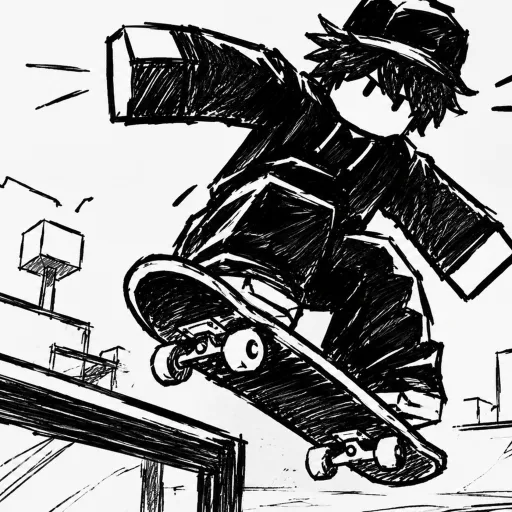
Tour the Skate Tree map: starting zone, street spot routes, the University District area and hidden paths for building longer trick lines.
Skate Tree Maps: University District and Spot Routes
Skate Tree's world is a canyon skate space with wooden ramps, rocky ledges and street-style spot routes, and its newest and largest area — the University District — is now official enough to sit in the game's own title. Plan lines around multi-obstacle routes, and treat one fan-favorite park's famous comparison as player talk, not provenance.
- Confirmed areas — the starting canyon zone and the University District (title-verified)
- Terrain vocabulary — ramps, rocky ledges, rails and street features built for lines
- Server size — up to 12 skaters sharing every spot
- Line strategy — loop multi-obstacle routes instead of skating dead-end ledges
The Starting Zone: Canyon Skate Space
Everything public evidence shows about Skate Tree's base map reads as one continuous canyon environment. The game's own official artwork sets the visual vocabulary: blue canyon skies, pine trees, a teal tower landmark, wooden quarter-pipe ramps, and rocky ledges running along the canyon floor. The community wiki's spot pages describe the same shape — street spots threaded through a canyon rather than separate instanced levels.
That structure matters for how you skate it. A canyon that reads as one space means spots connect: you can roll from a ramp into a ledge stretch into a rail without loading anything, which is exactly what combo lines need. The beginner-friendly read of the starting zone:
| Terrain | How It Skates |
|---|---|
| Wooden ramps | Speed generation and aerials — your line's engine and finisher |
| Rocky ledges | Grind surfaces and line midpoints |
| Rails | The connective tissue between bigger features |
| Open canyon floor | Flat-ground trick practice and approach runs |
No tracker has published a named spot directory for the starting zone yet — the game was ten days old at writing, and detailed map write-ups are still landing. The community wiki's spots pages are the closest living document; check them for player-named spots as they grow.
The University District
The University District is confirmed by the single most authoritative source possible: the game's own name. As of October 13, 2026, Roblox's game data lists the title as UNIVERSITY DISTRICT Skate Tree — the developer renamed the game to advertise the area.
Official source: UNIVERSITY DISTRICT Skate Tree on Roblox — Roblox's listing carries the district name in the game title itself, and the listing's last-updated stamp reads October 13, 2026.
What the district contains, block by block, is not yet documented by any authoritative source. The exact date it went live is also unconfirmed — community patch trackers and the game's own update stamps disagree, so this page does not stamp a date on it. What players should know: it exists, it is current enough that the developer put it in the title, and it is the area most worth exploring for fresh spots while the starting canyon's lines are already memorized by regulars.
New areas draw the crowd first. Skating the University District's opening days means fewer veterans camping its ledges, which makes it the friendlier place to practice line building while the starting zone stays busy.
The Black Box Conversation
One fan-favorite spot in player discussion is a park-style area that a commenter on a popular Reddit thread about the game called "an original skate 3 map, it's the Black Box DLC park." That is a player's characterization, and the distinction matters: Black Box Distribution Skate Park was a real DLC skate park in EA's Skate 3, documented on the Skate wiki, and players who know both spaces say the layouts rhyme.
The careful reading: Skate Tree is an original Roblox game by RNE Third Vault whose description states outright that it is not affiliated with EA in any way. Players comparing its park to a classic skate game's DLC park is community commentary on shared design language — plaza geometry, ledges, rails and transition flows that any real-world-inspired park shares. No source establishes provenance beyond that comparison, and none should be quoted as if it did.
The practical takeaway survives the caveat either way: park-style areas — open plazas ringed by grindable edges with central features — reward a different line style than the canyon. Canyon lines flow; park lines orbit. See the tricks guide for how both feed combo building.
Hidden Paths and Line Routes
Nothing "hidden" about Skate Tree's paths has been confirmed by authoritative sources — no secret rooms or easter eggs appear in any tracker or wiki. What players describe instead is a routing discipline: the map's features are dense enough that the difference between a good and great session is which connections you skate, not which secrets you find.
The line-routing framework that fits the confirmed terrain:
- Anchor on a landmark. The teal tower and the ramp clusters read from a distance; pick one as your session's home base.
- Audit the connections. Roll every path between two features once at speed — the best line segments are approach angles, not the obstacles themselves.
- Loop, never dead-end. A route that returns to its start chains runs; a route that ends in a wall spends its time in pushes.
- Bank a battle spot. Note one ledge or ramp where the terrain favors clean landings — Spot Battles rounds reward skaters who already know their ground.
- Cross the district line. Once a route feels automatic, carry it into the University District and rebuild it on unfamiliar geometry.
That last step is the long-term progression loop the map structure offers: master a line vocabulary in the canyon, then translate it to new terrain as the developer adds areas.
Skating With 12 Players on One Map
Roblox's official listing caps servers at 12 players, and the world design — one connected canyon space rather than instanced arenas — means every skater shares the same spots. That shapes map etiquette and strategy both:
- Battles gather crowds. The community wiki's Spot Battles description implies fixed spot rotations; expect the best-documented ledges to be contested during peak hours.
- Off-peak is practice time. The same spots that host battle rotations at peak can be drilled alone off-peak — worth knowing if you are still landing tricks consistently.
- Watch higher-level traffic. Free-roam scoping is the fastest undocumented map guide there is: follow a strong skater for two minutes and you will see routes no wiki lists.
The server count is official; everything about how crowds distribute across spots is inference from that cap plus the community's battle-mode descriptions.
FAQ
How many maps are in Skate Tree?
Public evidence shows one connected canyon world containing the starting zone and the newer University District — not a menu of separate levels. Roblox's game data confirms the district as part of the current build via the game's title; no tracker documents additional standalone maps as of October 13, 2026.
Where is the University District?
In the game's title — Roblox lists the game as UNIVERSITY DISTRICT Skate Tree, confirming the area's existence in the current build. A full spot-by-spot breakdown has not been published by any authoritative source yet, so exploring it in-game is currently the best documentation available.
Is the Black Box park a Skate 3 map?
It is a park-style area that players compare to Skate 3's Black Box DLC park — a Reddit commenter's description, not an established fact. Skate Tree is an original Roblox game whose description states it is not affiliated with EA in any way. The comparison reflects shared park-design language, not confirmed provenance.
Are there hidden areas or secret spots in Skate Tree?
No hidden areas are confirmed by any tracker or the community wiki. What exists is dense, interconnected terrain — the routing framework on this page (looping routes, landmark anchors, audited approach angles) is how experienced skaters extract more from the known map.
Can I skate with friends on the same map?
Yes — servers hold up to 12 players per Roblox's official listing, and the connected world means everyone skates the same spots. Battles and free-roam share the space; there is no separate private-map mode documented in any source.
What is the best spot to learn lines on?
Somewhere with two or three connected features — a ramp feeding a ledge stretch with a rail between them. Exact named spots are not yet catalogued by authoritative sources, so pick any multi-obstacle chain in the starting canyon and loop it until it is automatic.
Related Guides
- Skate Tree beginner guide — the first-session plan that assumes you know nothing about the map yet.
- Skate Tree tricks guide — how flips, grinds and grabs convert this terrain into scoring lines.
- Skate Tree spot battles guide — the mode that turns map knowledge into round wins.
More Skate Tree Guides
What the Skate Tree Shop sells: board skins and cosmetics paid for with Points, plus the Redeem Code shortcut at the bottom of the shop screen.
How Spot Battles work in Skate Tree: take turns setting tricks on a spot, score points for clean landings and win with consistency over risk.
Every core trick in Skate Tree: how to kickflip, heelflip, grind rails and ledges, and chain combos for higher scores and cleaner lines.