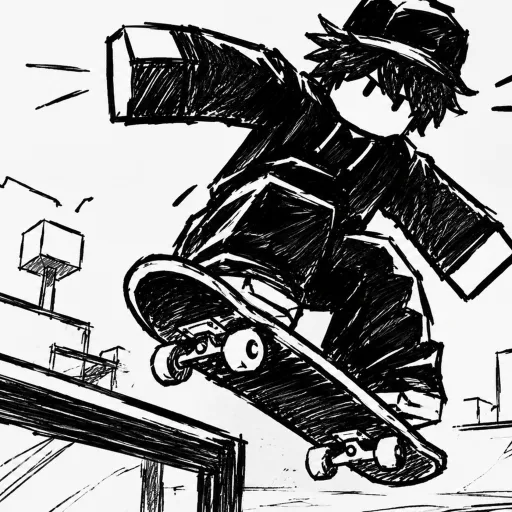
Every core trick in Skate Tree: how to kickflip, heelflip, grind rails and ledges, and chain combos for higher scores and cleaner lines.
Skate Tree Tricks: Kickflip, Grind and Combo Guide
Skate Tree's trick system spans flips, grinds, grabs and combo lines, all fired by directional stick flicks — and no authoritative input table has been published for any of them. The game's on-screen prompts show the real mappings. What is confirmed is the trick families and the practice framework that turns single tricks into scoring lines.
- Trick families — ollie, kickflip, heelflip, grind and grab per the community wiki
- Input method — flick the controls in different directions (GamesRadar walkthrough)
- Scoring truth — clean landings matter more than difficulty, especially in battles
- No published inputs — in-game prompts are the final mapping authority
The Trick Families
The community-maintained skatetree.wiki lists the core move set that public coverage agrees on:
| Family | What It Covers | Where It Scores |
|---|---|---|
| Ollie | The base pop — every other trick builds on it | Entry move for ledges, gaps and lines |
| Flip tricks | Kickflip, heelflip and the flip family | Flat-ground and gap scoring |
| Grinds | Locking the board onto rails and ledges | Spot tricks, battle rounds |
| Grabs | Catching the board mid-air | Airs off ramps and transitions |
| Combo lines | Chaining tricks together across a route | The real Points multiplier |
The developer's community channels have described the movement engine as covering flip tricks, grabs, grinds, manuals and vert moves, with combos and bailing on top — a broader description than the wiki's five-family shorthand. Both accounts describe the same design: a system built for linking moves rather than spamming one.
What neither source provides is the per-trick input. No flick direction is publicly confirmed for any specific trick, so this page teaches families, order and practice method — not invented button charts.
Skate Tree shows input prompts in the language of your active device. Sweep each stick direction on flat ground during your first session, note which trick fires, and you will have mapped the core moves faster than any webpage could tell you. The community wiki gives the same advice.
How Tricks Are Thrown
GamesRadar's walkthrough describes the input model in one line: you will need to flick the controls in different directions to pull off various tricks and moves and start racking up points. Stick flicks, directional variance, Points as the output — that is the confirmed loop.
The controller recommendation in the official description connects directly to this system. Analog sticks register the angle and snap of a flick; keyboards approximate it with discrete presses.
Official source: UNIVERSITY DISTRICT Skate Tree on Roblox — the description opens with "For the optimal experience, play on controller.", a recommendation that follows straight from the flick-based trick system.
Our controls guide breaks down both input methods and the community-reported layouts for each.
Two mechanics frame every trick attempt. You generate speed by skating — pumping ramps and rolling into approaches — because a trick thrown at walking speed scores and links nothing. And you can bail: the engine description includes bailing as a state, meaning missed landings are a designed consequence, not a freeze frame. Every trick decision is therefore a risk calculation against your landing.
Landing: The Skill Nobody Posts Clips About
Battles reveal the real scoring hierarchy. The community wiki's Spot Battles summary is blunt about it: clean landings score, and consistency matters more than difficulty. A landed kickflip beat a crashed triple-flip every round of every battle, because a bail scores zero and often loses your turn.
The landing practice framework that transfers from real skate coaching:
- Pop, rotate, catch, roll. Treat landing as its own phase — spot the ground mid-air, aim the wheels, absorb.
- Lower the trick ceiling. If a trick lands under half the time, drop to an easier variant until the land rate climbs.
- Land rolling forward. Landing while drifting sideways or backwards breaks the line and kills combo momentum.
- Bail deliberately while learning. When an approach goes wrong mid-air, reset rather than ghost-land — the R-to-reset habit (community-reported keyboard scheme) keeps practice sessions efficient.
Landing consistency is also the fastest Points strategy: a landed trick earns, a crashed trick does not, and long lines compound both. Our points guide covers the economy side of that math.
Building Combo Lines
Combo lines are where the system pays out. The design — flips, grinds and grabs chained across a route — rewards skaters who plan a path and execute it end to end rather than performing isolated tricks at random ledges.
The line-building framework that fits the confirmed map vocabulary:
- Pick a route with two or three hits. Ledge into rail into ramp works; a line with one obstacle is just a trick.
- Lead with your most reliable move. Open the line with the trick you land every time, not the one you land sometimes.
- Grind the middle. Rails and ledges extend airtime without demanding fresh flip inputs mid-line.
- Exit with an aerial. A ramp at the end lets you finish with a grab while the line is still alive.
- Link the route into itself. Circles beat dead ends — a loopable line chains into the next run without a long push-back.
Spot vocabulary here comes from the game's own canyon terrain — wooden ramps, rocky ledges, rails and street features — and the maps guide routes the spaces worth learning lines through, including the University District.
A One-Week Practice Order
New skaters benefit from a strict progression rather than menu-sampling every move at once:
| Day | Focus | Success Test |
|---|---|---|
| 1 | Ollie on flat, then rolling | 9 clean landings out of 10 attempts |
| 2 | Map flick directions | Name the trick each direction throws |
| 3 | One flip trick, repeating | Land it over half the time at speed |
| 4 | Grinds on one low rail | Lock and ride out three times consecutively |
| 5 | Grabs off one ramp | Clean airs without drifting off-line |
| 6 | Two-trick line | Flip into grind on the same route |
| 7 | Three-trick looped line | Full circuit twice without bailing |
The numbers are a coaching frame, not official thresholds — no tracker publishes success-rate benchmarks. What is official is the direction of travel: consistency outranks difficulty in battles, and every confirmed source — from GamesRadar's flick description to the wiki's battle rules — points the same way.
Where Battle Tricks Fit
Spot Battles and Game of Skate put the practice under pressure. In the community-reported rules, one player sets a trick and the rest mirror it; failing to copy earns a letter, and five letters — S-K-A-T-E — end your round. The strategy implication for your trick pool: a deep bag of medium-difficulty tricks beats three signature moves. If your keeper tricks are an ollie, one flip and one grind, you can survive most mirrored sets; if they are all technical flips, the first set outside your pool costs you a letter.
Our spot battles guide covers the full rule set and round strategy.
FAQ
How do I kickflip in Skate Tree?
No authoritative public input table exists for the kickflip — or any specific trick. The confirmed method is directional stick flicks, and the game's own on-screen prompts show the exact direction for your device. Pop an ollie, then sweep flick directions on flat ground until the kickflip fires.
What is the easiest trick to learn?
The ollie is the base everything builds on, and it is the right first trick — pop it rolling before attempting anything else. After that, one flip trick grounds your flat-game, and low-rail grinds extend lines. The community wiki's family list starts from exactly that order.
Why do I keep bailing on landings?
Most bails come from aiming tricks above your current landing rate. Battle scoring rewards consistency over difficulty, so drop to easier variants until landings are routine, and focus on catching the board and rolling forward rather than on the pop itself.
Are there combos in Skate Tree?
Yes — combo lines are a core part of the system. The movement engine description includes combos alongside flips, grabs, grinds, manuals and vert moves, and the community wiki lists combo lines as part of the core trick set. Chain tricks across a multi-obstacle route to build them.
Does flipping my board earn more Points than plain ollies?
No tracker publishes per-trick Point values, so exact multipliers are unconfirmed. What is confirmed: you earn Points by skating and performing tricks (ProGameGuides), and lines of landed tricks outperform single crashed attempts in battles, where clean landings are the scoring condition. Play landed lines, not risky singles.
Do trick inputs change between updates?
They can. The community wiki notes that its layout tables are inference-level and that in-game prompts are the final authority — the same caution applies after any update. Re-check the prompts if a familiar flick stops firing.
Related Guides
- Skate Tree controls guide — controller and keyboard layouts behind every flick on this page.
- Skate Tree spot battles guide — the mode where landing consistency turns into round wins.
- Skate Tree points guide — how landed lines convert into the currency the Shop spends.
- Skate Tree maps guide — the ledges, rails and ramps these lines run through.
More Skate Tree Guides
Best Skate Tree settings: controller setup, camera and landing options, plus the performance mode players mention for smoother frames on Roblox.
What the Skate Tree Shop sells: board skins and cosmetics paid for with Points, plus the Redeem Code shortcut at the bottom of the shop screen.
How Spot Battles work in Skate Tree: take turns setting tricks on a spot, score points for clean landings and win with consistency over risk.