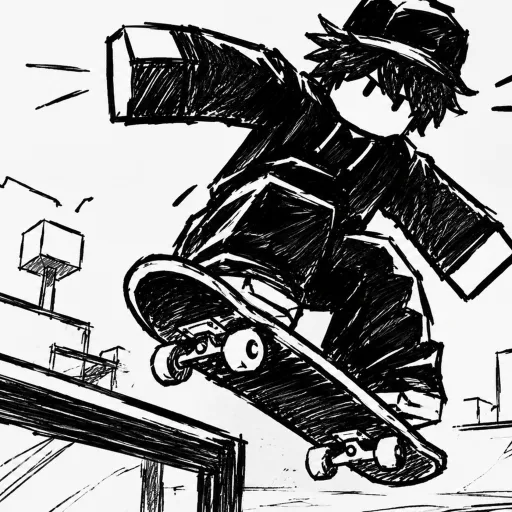
How Spot Battles work in Skate Tree: take turns setting tricks on a spot, score points for clean landings and win with consistency over risk.
Skate Tree Spot Battles: Rules and Winning Tips
Spot Battles is Skate Tree's headline competitive mode: skaters take turns setting tricks on one shared spot, and only cleanly landed tricks score. The rules are community-documented rather than published by the developer, servers hold up to 12 players, and the advice players repeat most often is that consistency beats difficulty every single round.
- Turn-based exchanges — one skater sets a trick, the rest answer on the same spot
- Clean landings only — a bail scores nothing under the community ruleset
- 12 players per server — Roblox's official stats list a 12-player cap
- Consistency over risk — landed basics beat missed hammers over a full session
- Sister format — Game of Skate runs inside the same battle system
How a Spot Battle Round Works
A Spot Battle is built around one piece of street terrain. Players pick a spot — a ledge, a rail, a set of stairs, a gap — and then take turns setting tricks on it. When it is your turn you perform a trick; when it is someone else's turn you have to answer with a trick of your own on the same obstacle. Every trick has to be landed cleanly to count, and a bail throws the exchange away.
That clean-landing rule is what shapes the whole mode. A battle is not a best-tricks contest where the biggest flip wins on paper; it is a test of who can keep putting board to ground while the other person starts pressing. The community ruleset collected on the Skate Tree community wiki describes wins feeding your progress in the mode, though the developer has not published a point table or ranking system — treat progression rewards as community-reported until an official rules page exists.
Treat the opening rounds as a filter: land comfortable tricks cleanly, watch what your opponent keeps missing, and only escalate once you have a read. Battles are won by the skater who is still landing when everyone else starts bailing.
Official source: Skate Tree on Roblox — the official game page for the experience, whose description also states the game is not affiliated with EA in any way, shape, or form.
Servers, Stats and Who You Will Face
Roblox's own statistics for the experience give a concrete picture of the lobbies you drop into. Servers cap at 12 players, so a busy battle lobby is a dozen skaters rotating through one spot rather than a massive queue. At the last official read, the game had logged 994,280 visits and a 97 percent approval rating from 5,032 positive versus 149 negative votes, with about 1,376 players online at the moment of checking.
| Stat | Official value |
|---|---|
| Max players per server | 12 |
| Total visits | 994,280 |
| Approval rating | 97% (5,032 up / 149 down) |
| Playing at check time | 1,376 |
| Experience created | October 3, 2026 |
| Experience updated | October 13, 2026 |
Official source: Roblox official game stats — the official statistics behind the table, checked October 13, 2026.
The 12-player cap shapes battles in practical ways. Lobbies rotate fast, opponents change constantly, and there is no persistent ladder remembering your record across sessions — a battle you win is known to the people in the server and nobody else. Hopping lobbies to find a fresh spot with new opponents is a normal part of the mode, not a sweaty exploit.
Why Consistency Beats Difficulty
Every write-up on the battle rules lands on the same strategic point: a trick you land every attempt is worth more than a trick you land one time in five. Bails do not score, and a turn-based format punishes risk slowly and then all at once — you can look fine for four rounds and lose the last three exchanges because you had no safe trick to fall back on.
That is why battle-ready players build a small rotation before they chase size. The community trick lists point to the usual families — flips, grinds, grabs and manuals — and most competitive players live off two or three comfortably landed flips plus one grind they trust more than the rest. The tricks guide covers how those families practice, and the controls guide covers the input setup that makes repeatable landings possible in the first place.
Terrain choice is the second half of consistency. Setting your trick over the part of the spot where you have the cleanest approach — not the hardest one — forces your opponent onto terrain that favors you. It sounds small until you watch a battle swing because one player kept setting over the kinked end of a rail that nobody could lock onto.
Spot Battles vs Game of Skate
Skate Tree carries two battle-flavored formats and players use the names loosely, so the distinction is worth pinning down. Spot Battles is the broader container: turn-based trick exchange on a chosen spot where clean landings score. Game of Skate is the letter-based format living inside that system — one skater sets a trick, everyone copies it, and missed attempts earn letters until someone spells S-K-A-T-E and is out.
The practical difference is the shape of the pressure. Spot Battles rewards steady scoring across a session; Game of Skate is sudden-death arithmetic where one unlanded trick costs a letter immediately, and being behind means you cannot afford to miss twice. Our Game of Skate guide breaks down the letter economy and the setting strategy that goes with it.
There is also a social layer: battles are organized by the players in the server, so the format, trick difficulty and length are whatever the group agrees on before the first trick. Agreeing out loud before starting saves the rematch arguments that otherwise end with someone leaving the lobby.
Why Everyone Compares It to a Certain Classic
Skate Tree launched into a wave of coverage and player clips that all point at the same comparison. YouTube uploads titled things like "SKATE 3 IS NOW ON ROBLOX" and the Reddit thread "Skate 3 in Roblox is actually decent" are typical samples of how players introduce the game, and Spot Battles is the mode those clips usually show. GamesRadar's codes coverage put the relationship most cleanly: the game "may look similar to an EA classic but is entirely unrelated."
The developer states in the official description that the game is not affiliated with EA in any way, shape, or form, and has made no claim of any official connection. Treat the Skate 3 comparisons as player shorthand for the physics and spot design, nothing more.
That framing also sets expectations. Spot Battles will feel familiar to anyone who spent evenings trading tricks in a console skate game, but everything here runs inside Roblox: 12-player servers, community-run rule sets, and a progression economy on in-game Points instead of a decade of console polish.
FAQ
How do I start a Spot Battle in Skate Tree?
There is no documented ranked queue or matchmaking button. Community write-ups describe battles as player-organized: find a spot in a server, agree on the format with whoever is skating there, and start trading tricks. Lobbies hold up to 12 players, so busy spots usually gather a crowd on their own.
Do clean landings really matter more than hard tricks?
Yes, under the community ruleset. A bail scores nothing, and battles rotate turns, so missed tricks hand your opponent free exchanges. Nearly every player guide on the mode recommends landing tricks you can repeat over throwing ones you only land occasionally.
Is there a ranking or elo system for Spot Battles?
Not that any tracker or the community wiki documents. Wins are said to feed progress in the mode, but there is no published ladder, rating or seasonal leaderboard, and the developer has not announced one. Track your own win streak if you want a personal metric.
Can I play Spot Battles on keyboard or mobile?
Community pages report the game runs on PC, mobile and consoles, and battles use the same movement and trick controls as free skating. The official description recommends a controller for the optimal experience, and that advice hits hardest here, where clean landings decide everything.
Related Guides
- Skate Tree Game of Skate rules — the letter-elimination format that lives inside the battle system.
- Skate Tree tricks guide — build the small trick rotation that battle consistency demands.
- Skate Tree controls guide — controller and keyboard inputs behind repeatable landings.
- Skate Tree maps and spots — where to find the terrain battles are actually played on.
More Skate Tree Guides
Best Skate Tree settings: controller setup, camera and landing options, plus the performance mode players mention for smoother frames on Roblox.
What the Skate Tree Shop sells: board skins and cosmetics paid for with Points, plus the Redeem Code shortcut at the bottom of the shop screen.
Every core trick in Skate Tree: how to kickflip, heelflip, grind rails and ledges, and chain combos for higher scores and cleaner lines.