
First Person Boxing stamina explained: the fatigue bar, cardio, why getting tired slows you down, and how to pace a fight without gassing out.
First Person Boxing Stamina Guide
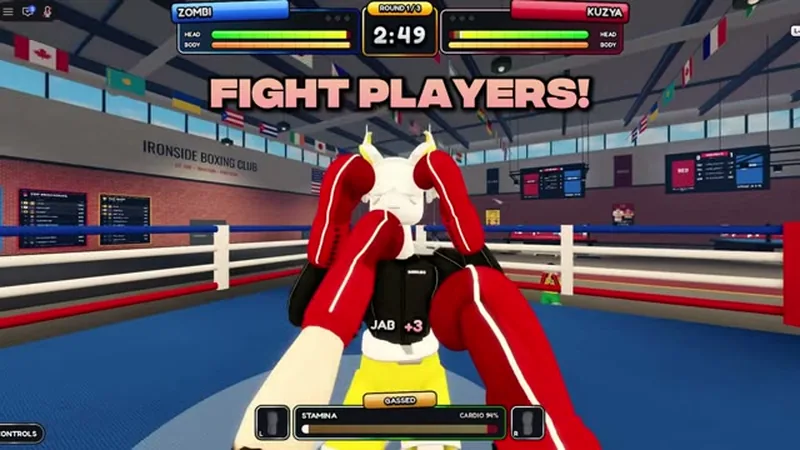
Stamina is the only resource in First Person Boxing that you cannot buy. The official description says it plainly — "Manage your stamina, getting tired slows you down" — and the fight HUD backs it up with a STAMINA bar and a CARDIO percentage along the bottom of the screen. Run the bar dry and your character moves slower than the opponent, which turns a winning exchange into a lost one.
- The bar — STAMINA, horizontal, bottom centre of the HUD
- The readout — CARDIO, shown as a percentage (100% in the preview)
- The penalty — an empty bar slows you down
- The rule — never open a combination below half a bar
- The fix — short bursts, then a deliberate disengage
What the Bar Is Actually Measuring
Every action in this game draws from one pool. Punches cost stamina. Slips cost stamina. Guards cost stamina. That single-pool design is why the game slows you down when you are tired instead of simply reducing your damage: the penalty is mobility, so running out affects defence as well as offence.
The CARDIO readout sits next to the bar and reads 100% in the official preview. Treat it as the recovery side of the same system — the number that tells you how quickly the bar comes back. The game does not publish the recovery formula, so the practical approach is to watch both numbers together: the bar tells you what you have, cardio tells you how fast you get it back.
The Half-Bar Rule
The most useful rule for a new player is mechanical: do not start a combination with less than half a bar.
The reason is arithmetic. A combination that empties your bar leaves you slow. A slow fighter cannot disengage, which means the opponent's next exchange happens on their terms, at their timing, with your defence unavailable. Half a bar is the reserve you need to throw the combination and leave.
Players who ignore this rule describe the game as "unfair" or "laggy," because their character keeps getting caught. It is not lag. It is the stamina penalty doing exactly what the description says it does.
The instinct after landing a good shot is to throw one more. That extra punch is usually the one that empties the bar. End the exchange a punch early, recover, and you will win the next exchange — which is worth more than the chip damage you gave up.
Reading Your Own Bar Mid-Fight
The HUD sits at the bottom of the screen, below your gloves, which is exactly where a first-person player is least likely to look. Two habits fix that:
- Check on the disengage. Every time you step out, glance down. The disengage is the natural moment because nothing is incoming.
- Check after every slip. A slip is a full-body action and it is expensive. If you slipped twice in a row, you are probably lower than you think.
Players who watch only the opponent's health bar lose exchanges they were winning thirty seconds earlier. The stamina bar is the actual scoreboard.
Stamina and the Guard Decision
Guarding is not free, and this changes the defensive calculus from the slip and counter guide.
A held guard costs stamina continuously. Against a volume puncher, holding a guard is a losing trade: they spend a little per punch, you spend steadily just to stay covered, and eventually you are slow while they are still fresh.
That is the situation where slipping becomes cheaper than blocking. A slip is a discrete cost paid once, and if it works you also create a counter window. The defensive hierarchy is therefore not "block good, slip fancy" but:
- Slip the committed punch — best case, costs once and creates offence.
- Guard the fast punch — acceptable, but stop holding it.
- Hold a guard against volume — worst case, drains you while doing nothing.
Pacing a Three-Minute Round
The round timer in the preview starts around three minutes. That is long enough that pacing matters and short enough that you cannot simply wait out a tired opponent forever.
A workable structure:
- First minute: read. Throw single committed punches. Watch how the opponent answers. Do not chase.
- Second minute: exploit. You now know their default guard zone. Attack the other one, and counter the committed punch they use when you pressure.
- Third minute: spend. If the opponent's bar is lower than yours, this is when volume wins. If yours is lower, this is when you defend and counter.
The mistake is spending the third minute's stamina in the first thirty seconds, which is what most new players do.
Stamina and Style Choice
Styles change how your punches, guards and counters behave, which indirectly changes your stamina economy. A defensive shell style tends to reward patience; a pressure style rewards bursts and punishes long exchanges.
The styles guide covers the confirmed names, and the tier list ranks them. The stamina takeaway is that you should pick a style whose rhythm you can sustain for three minutes, not one that looks strongest on paper.
Building the Habit in Ten Fights
Stamina discipline is a habit, not knowledge. The fastest way to build it:
- Fights 1–3: never let the bar drop below half. Accept losing rounds you could have won.
- Fights 4–6: add one deliberate disengage per exchange, even when you are winning.
- Fights 7–10: start checking the opponent's bar as often as your own. Whoever is lower is the one who has to disengage next.
By fight ten the bar becomes background information rather than a surprise.
Sources and Further Reading
- The official group behind the game: the official Can You Box? group
- Code payouts and the redeem path: GameRant's First Person Boxing code list
Official source: First Person Boxing on Roblox — the official description states that players must manage stamina and that getting tired slows them down.
Frequently Asked Questions
What happens when stamina runs out in First Person Boxing? Your character slows down. The official description says getting tired slows you down, and the HUD's stamina bar is the warning.
What is CARDIO in First Person Boxing? A percentage readout next to the stamina bar, reading 100% by default in official footage. It represents the recovery side of the stamina system.
Do guards cost stamina? Yes. Guarding is a held state and draws on the same pool as punching and slipping.
How do I recover stamina faster? Disengage. The game does not publish a recovery formula, but stepping out of range and stopping actions is the only reliable way to let the bar refill.
Is stamina the same for every style? The game does not publish per-style stamina numbers. Styles change how punches, guards and counters behave, which changes how much you spend in practice.
More First Person Boxing Guides
How slip, guards and counters actually work in First Person Boxing: the counter window, head versus body guards, and the habits that land COUNTER HIT.
First Person Boxing styles guide: the Roll Styles screen, the five rarity tiers, the confirmed style names, drop rates and the 40-spin legendary pity.
A First Person Boxing style tier list built only from confirmed names and rarities, with what each tier means and how to judge a style yourself.